TeraFab · Compute · Starship · 8 min read
A Hundred Gigawatts a Year
A million tons a year at 100 kW per ton is 100 GW of new orbital compute. A path to 1 TW a year from Earth. The math is not a constellation.
The well cannot feed the mind
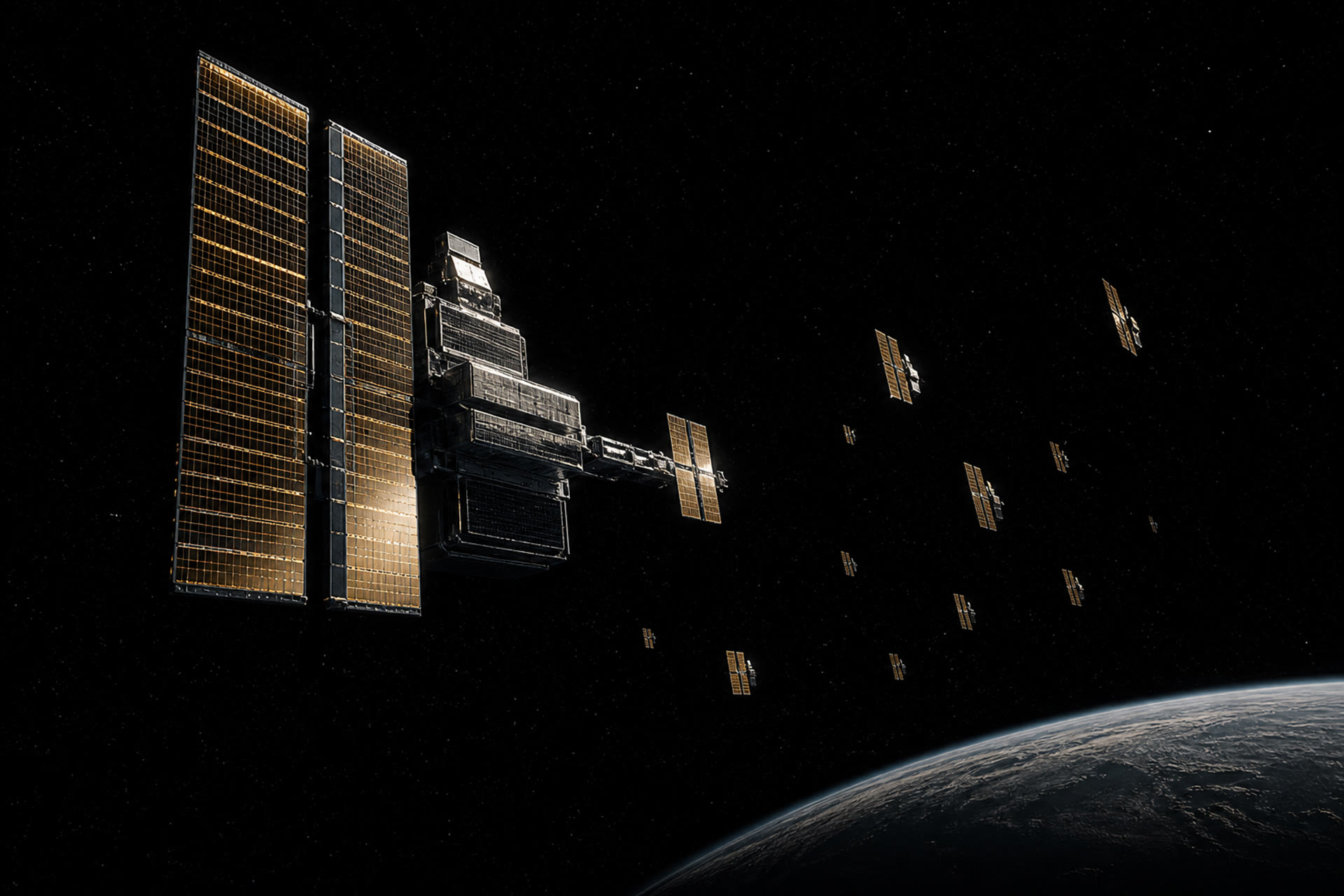
On 2 February 2026 SpaceX published the acquisition of xAI and, in the same breath, the reason a fab on Earth is not enough. Current AI depends on large terrestrial data centers that want immense power and cooling. Global electricity demand for AI, the page said, cannot be met with terrestrial solutions even in the near term without hardship on communities and the environment. In the long term, space-based AI is the only way to scale. To harness even a millionth of the Sun’s energy would take over a million times more energy than civilization currently uses. The only logical solution is to move the hungry work to a place with vast power and space. By harnessing near-constant solar with little operating or maintenance cost, satellites transform the ability to scale compute. Launching a constellation of a million satellites that operate as orbital data centers is printed as a first step toward a Kardashev II civilization — one that can harness the Sun’s full power — while supporting AI for billions of people today and a multi-planetary future. A first step is not a Dyson swarm. A million satellites is not a flown count.
Three thousand tons was a record year
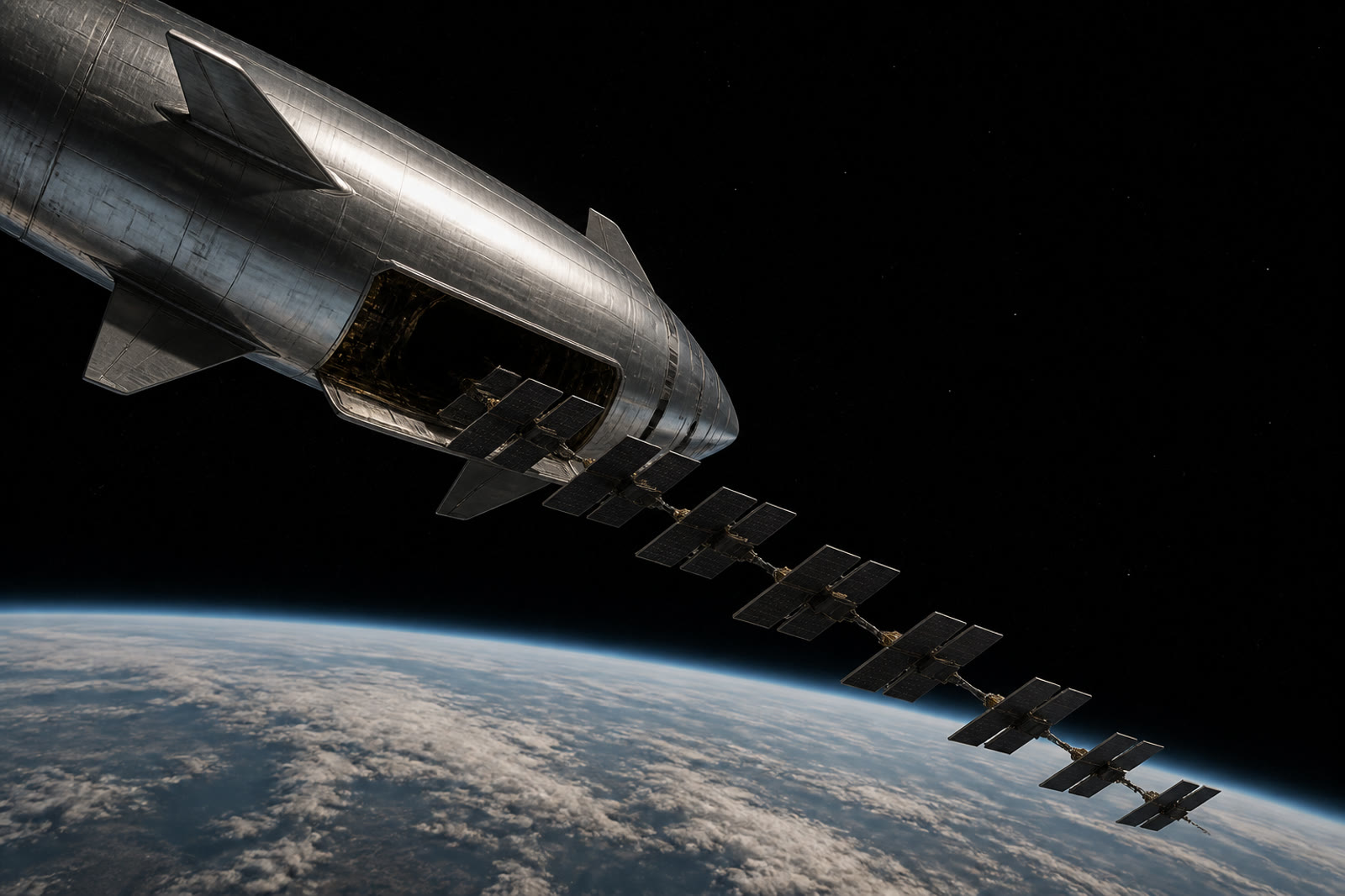
In the history of spaceflight, SpaceX wrote, there has never been a vehicle capable of launching the megatons of mass that space-based data centers, permanent lunar bases, and cities on Mars require. Even in 2025, the most prolific year in orbital launches, only about 3,000 tons of payload went to orbit, primarily Starlink on Falcon. The need to launch thousands of satellites was a forcing function for Falcon. This year, the February page said, Starship will begin delivering much more powerful V3 Starlink satellites, each launch adding more than 20 times the capacity of current Falcon V2 Starlink flights, plus the next generation of direct-to-mobile satellites. Space-based data centers push that forcing function further. With launches every hour carrying 200 tons per flight, Starship will deliver millions of tons to orbit and beyond per year. That cadence sentence is a design load. It is not a flown hour. This desk will not invent a 2026 flight rate from it.
- 2025 to orbit — about 3,000 tons, mostly Falcon Starlink
- V3 Starlink — each Starship launch >20× Falcon V2 capacity (Feb 2026 page)
- Cadence load — launches every hour, 200 t per flight
- Mass load — millions of tons to orbit and beyond per year
The arithmetic
The basic math, SpaceX printed, is that launching a million tons per year of satellites generating 100 kW of compute power per ton would add 100 gigawatts of AI compute capacity annually, with no ongoing operational or maintenance needs. Ultimately there is a path to launching 1 TW per year from Earth. The estimate on that page: within two to three years, the lowest-cost way to generate AI compute will be in space. terafab.ai puts the Earth-side costs in a column — power build, permitting, operating cost, land, energy, infrastructure, cooling — and the space-side column is shorter: launch, operating cost, satellite build, infrastructure. That comparison is an argument. It is not a flown invoice. The same February page says the new constellation will reuse Starlink’s end-of-life disposal playbook. Disposal is a design claim. A hundred gigawatts a year is still a product of tons and watts per ton. Miss either number and the year does not close.
- 1,000,000 t/year × 100 kW/t = 100 GW/year of new orbital compute
- Path from Earth — 1 TW/year
- Estimate — lowest-cost AI compute in space within 2–3 years (Feb 2026)
- Disposal — existing Starlink end-of-life strategies, claimed
The Moon is the second factory
Launching AI satellites from Earth is the immediate focus. Starship’s in-space propellant transfer is what lets the same vehicle land massive cargo on the Moon. Once there, factories can use lunar resources to manufacture satellites and throw them farther. An electromagnetic mass driver plus lunar manufacturing is printed as 500 to 1,000 TW per year of AI satellites into deep space — a non-trivial percentage of the Sun’s power, a meaningful step up the Kardashev scale. The capabilities unlocked by space-based data centers, the page said, will fund and enable self-growing bases on the Moon, a civilization on Mars, and expansion into the universe. That is the funding sentence. It is not a landed tonne on Mars and it is not a thrown tonne off the Moon. The 2026 gates have not moved. V3. Long-duration flight. Cryogenic transfer. Without the transfer, Starship stays a heavy-lift vehicle. Without the fab, the satellite is a hull. Without the catch, the next hull does not leave. One machine.
The desk load
The Dossier already carried a thin TeraFab loop: an 80/20 chip split, a million wafer starts a month at Grimes County, 100 GW a year as a million tons to orbit. Those X-desk numbers now have a first-party twin. 100 kW per ton times a million tons is the same 100 GW. One terawatt a year is the Earth-side path. Five hundred to a thousand terawatts a year is the lunar throw, not this decade’s pad. Ice, 2,400 tonnes of return propellant, and 3.6 megawatts of surface baseload have not moved. They live in The Last Meters of Dust and Powering Mars. This paper is the launch math SpaceX printed on 2 February. Three thousand tons was a record year. A hundred gigawatts a year is the next forcing function. The city is a different machine.
Selected primary sources
SpaceX Updates, “xAI joins SpaceX to Accelerate Humanity’s Future,” 2 February 2026, https://www.spacex.com/updates/xai-joins-spacex. Terafab, https://terafab.ai. SpaceX Updates, “Breaking Ground on Terafab in Texas,” 6 August 2026, https://www.spacex.com/updates/terafab. SpaceX Updates, “Introducing Starship V3,” 12 May 2026, https://www.spacex.com/updates/starship-v3. The 2 February 2026 desk is the source for the xAI acquisition sentence, the claim that terrestrial power cannot meet near-term AI demand without hardship, space-based AI as the long-term scale path, a million-satellite orbital-data-center first step, ~3,000 tons to orbit in 2025, V3 Starlink at more than 20× Falcon V2 capacity per launch, hourly 200-ton cadence as a load, 1,000,000 t/year × 100 kW/t = 100 GW/year, a path to 1 TW/year from Earth, the 2–3 year lowest-cost estimate, and the lunar mass-driver range of 500–1,000 TW/year. SpaceX has not published a flown orbital data center or a lunar throw. This desk will not borrow one.
Ask this paper
Grok answers from this essay only. Sign in so the call stays on your session — one question at a time.
Sign in to askNext
Starship Flight 14