Perseverance · Jezero · Geology · 7 min read
The Floor Was Not the Lake
They picked Jezero for the delta. The first rocks were magma.
They picked Jezero for the delta. The first rocks were magma.
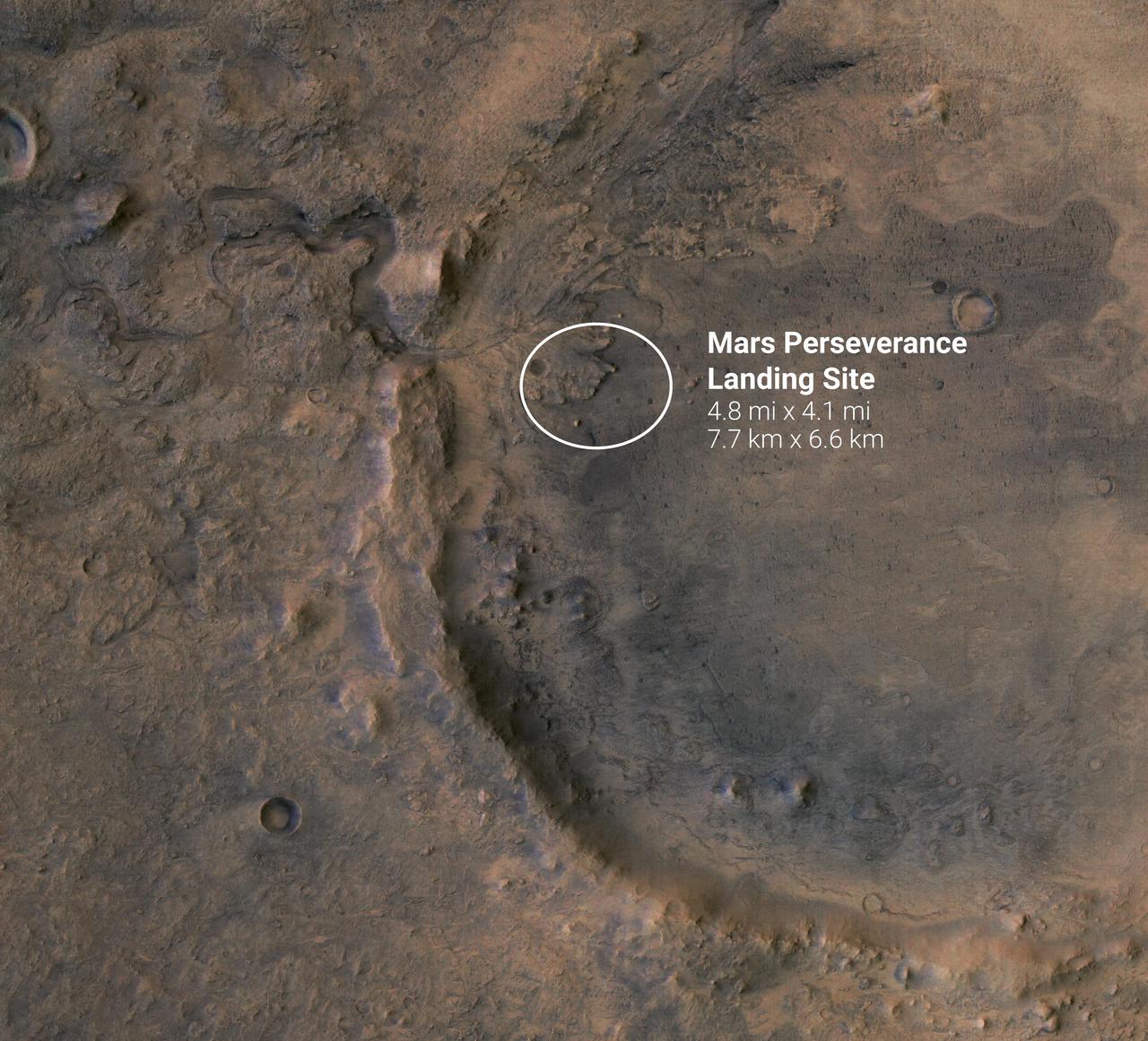
They picked Jezero for the delta. The first rocks were magma. NASA spent five years on more than sixty landing sites and then chose a 28-mile-wide crater on the western edge of Isidis Planitia. A later impact had punched Jezero into a basin about 750 miles across. Rivers once ran in. A lake several hundred feet deep once sat there. The western fan — clay, carbonate, the shape of an old shoreline — is why the ellipse exists. The published landing ellipse is 4.8 by 4.1 miles. Perseverance is on the floor on 18 February 2021.
The first expectation is sedimentary rock
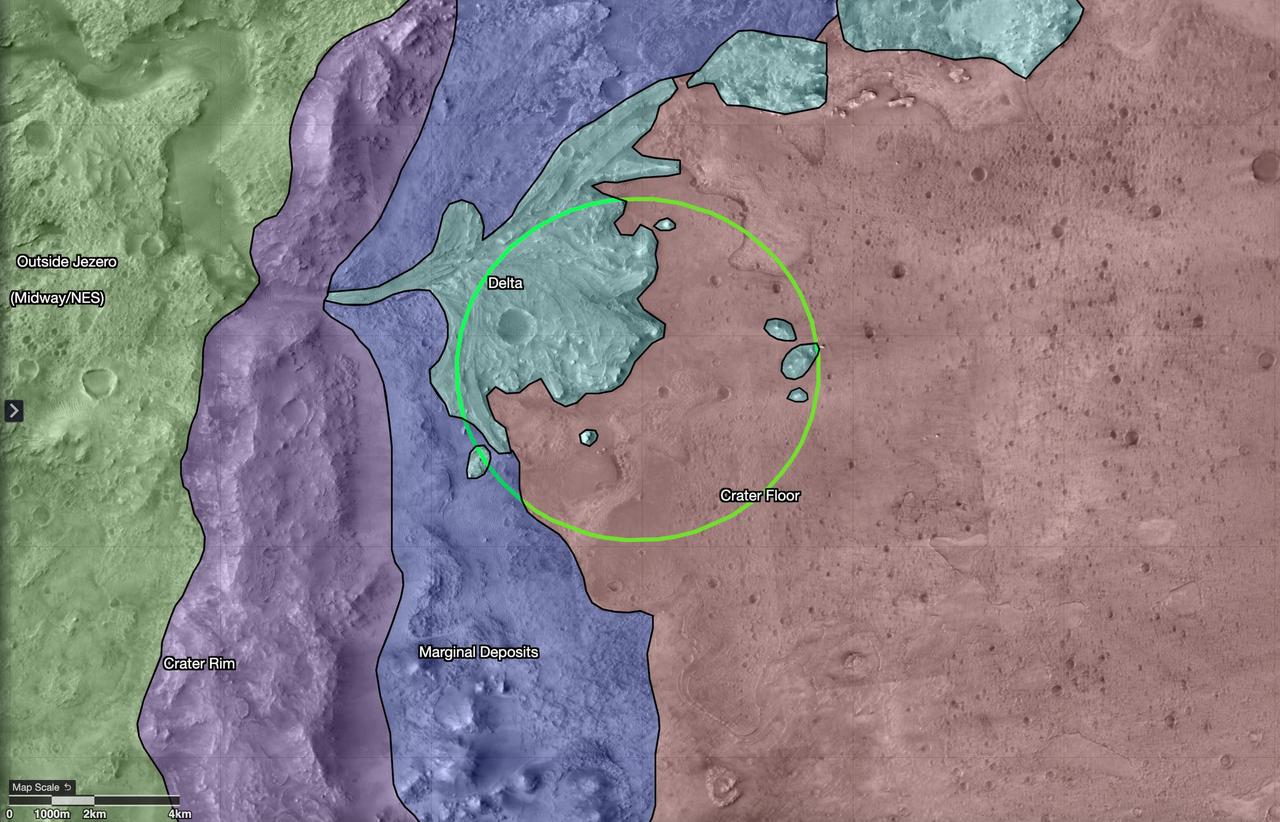
The first expectation is sedimentary rock. A lake should leave sand and mud. What the rover finds on the floor is not a lakebed. It is two igneous units, stacked, then altered by water that was never a standing sea on that surface.
Séítah is the lower unit
Séítah is the lower unit. Coarsely crystalline. Olivine-rich. NASA and the Science papers read it as rock that accumulated at the base of a magma body — a slow cool, not a flood of mud. Magnesium-iron carbonates sit along grain boundaries. That is water, but water-poor and carbon-dioxide-rich: a reaction film, not a delta.
Máaz sits on top
Máaz sits on top. Interlocking crystals of pyroxene and plagioclase, half a millimeter to a millimeter. Lava flows, or the chemical complement to Séítah in the same layered igneous body. Later, voids take sulfates and perchlorates. NASA’s language is near-surface brine evaporation, after the igneous rock already existed.
RIMFAX is the first ground-penetrating radar on the Martian surface
RIMFAX is the first ground-penetrating radar on the Martian surface. It sounds the floor to about 50 feet — 15 meters. Inclined layers show up at up to 15 degrees underground. That is a published instrument depth. It is not a basement for a city, and this desk will not write one.
Ken Farley’s overview paper, 25 August 2022
Ken Farley’s overview paper, 25 August 2022: the crater held an open-system lake prior to about 3.5 billion years ago. Major climate change then left Mars cold and dry. The rover lands about two kilometers from the delta, on the floor, because the floor has to be read before the fan can be trusted. Four papers come out the same day. Two in Science, two in Science Advances. SuperCam’s laser and RIMFAX are what pin the igneous floor. NASA’s own headline is the surprise: they expected sediment. They got magma.
This is a flown fact
This is a flown fact. The vehicle did this. The cores from Máaz and Séítah are in the cache. Return of those tubes is a future mission NASA and ESA are designing. It is not a crew. It is not a landing year. It is not closed here.
Then the rover goes to the delta anyway
Then the rover goes to the delta anyway. That was always the primary goal. The 2022 Mastcam-Z mosaic of the fan — 1,118 frames, 2.5 billion pixels — is the most detailed landscape panorama then returned from Mars. Deltas remain the better place to look for preserved organics. The floor was the sample you take first so you do not lie about what the lake sat on.
The campaigns after the floor have names
The campaigns after the floor have names: Fan Front, Upper Fan, Margin Unit. They are later papers. This one stays on the surprise. A lake that died is not a settlement plan. A cache is not a city. A delta is not a floor.
Selected primary sources
NASA, “NASA Announces Landing Site for Mars 2020 Rover,” 19 November 2018, https://www.nasa.gov/news-release/nasa-announces-landing-site-for-mars-2020-rover/. Jezero as 28-mile / 45 km crater, western Isidis, ancient river delta, clays and carbonates. NASA Science, “Jezero Crater: Mars 2020 Rover Landing Site,” https://science.nasa.gov/resource/jezero-crater-mars-2020-rover-landing-site/. NASA, “NASA’s Perseverance Makes New Discoveries in Mars’ Jezero Crater,” 25 August 2022, https://www.nasa.gov/missions/mars-2020-perseverance/perseverance-rover/nasas-perseverance-makes-new-discoveries-in-mars-jezero-crater/. Floor expected sedimentary, found two igneous types; RIMFAX to 50 feet / 15 m; four papers that day. Farley et al., “Aqueously altered igneous rocks sampled on the floor of Jezero crater, Mars,” Science, 2022, https://www.science.org/doi/10.1126/science.abo2196. Séítah olivine cumulate; Máaz lava or complement; carbonates; sulfates and perchlorates in voids; cores cached. NASA Science, “Detailed Panorama of Mars’ Jezero Crater Delta,” 14 September 2022, https://science.nasa.gov/resource/detailed-panorama-of-mars-jezero-crater-delta/. 1,118-frame Mastcam-Z mosaic. PIA24350, 8 January 2021, https://photojournal.jpl.nasa.gov/catalog/PIA24350. Landing ellipse 4.8×4.1 miles; lake several hundred feet deep. Credit ESA/DLR/FU-Berlin/NASA/JPL-Caltech. PIA23976, https://photojournal.jpl.nasa.gov/catalog/PIA23976. Regional map. Credit NASA/JPL-Caltech. This desk labeled the igneous floor as flown rover fact and sample return as an unclosed future mission. It did not invent a landing, a crew, a city, or ore. Do not duplicate /research/rock-that-broke-open-mars (Gale / native sulfur).
Ask this paper
Grok answers from this essay only. Sign in so the call stays on your session — one question at a time.
Sign in to askNext
Starship Flight 14