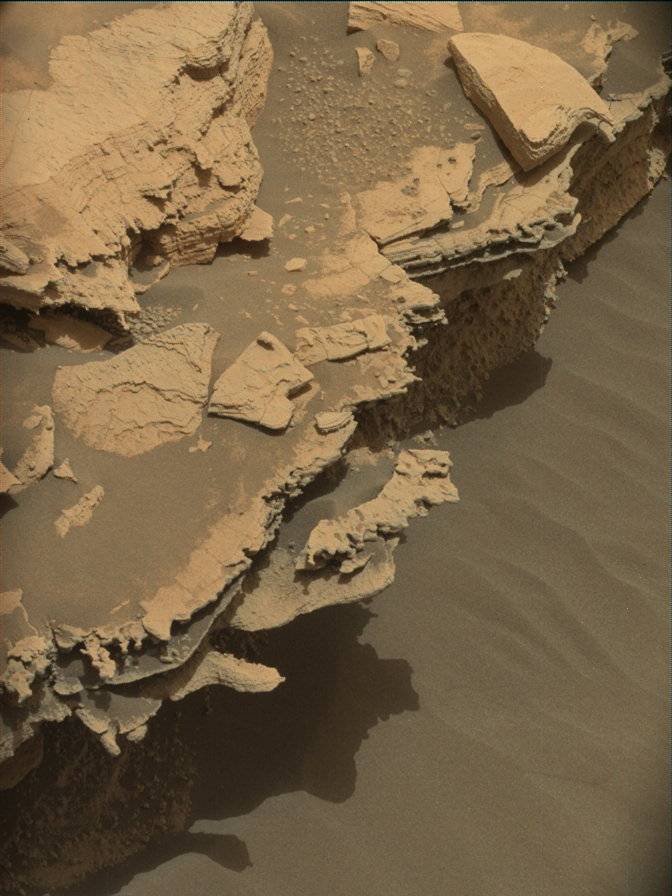
Curiosity · Gale · Carbonates · Habitability · Kite · 10 min read
Fluctuating Habitability
Water made the wet windows. Carbonate closed them.
Water made the wet windows. Carbonate closed them.
Water made the wet windows. Carbonate closed them. After about 3.5 billion years ago, liquid water on Mars helped lock carbon into rock, which thinned the greenhouse, which shut the wet windows. Kite et al. (Nature 2025) call it fluctuating habitability on a self-regulating desert planet. Tutolo et al. (Science 2025) supplied the missing in-situ carbonate. Chemistry and escape were co-dependent. Solar-wind stripping is not obsolete.
The hypothesis, stated carefully
This is not a new named law. “Self-terminating habitability” is a useful frame for a real mechanism: after about 3.5 billion years ago, liquid water on Mars helped lock carbon into rock, which thinned the greenhouse, which shut the wet windows. Kite and colleagues call the outcome fluctuating habitability on a self-regulating desert planet. Tutolo and colleagues supplied the missing in-situ carbonate. Together they replace the older story that solar-wind stripping alone ended surface habitability. Scope matters. The published Kite runs describe Mars after ~3.5 Ga. They do not erase a possibly wetter Noachian valley-network era. Physical escape to space still happened; MAVEN argon isotopes require it. Chemistry and escape were co-dependent. Stripping is not obsolete.
Curiosity's siderite — Gale, Mount Sharp
CheMin XRD on an 89-meter section. Three drills in the magnesium-sulfate–bearing Chenapau member of the Mirador formation: Tapo Caparo 10.5 ± 0.5 wt% siderite; Ubajara 4.8 ± 0.3 wt%; Sequoia 7.6 ± 0.4 wt%. That is the 4.8–10.5 wt% line. Water-limited formation with evaporation. If similar sulfate strata are global, Tutolo estimates 2.6–36 mbar CO₂ equivalent. Orbit missed it — Mg-sulfate masks carbonate bands. Margin Unit 16 wt% is Jezero, not these CheMin numbers.
Four-stage sketch — model, not a measured cycle log
The teaching sketch is pedagogical. Kite’s published engine is slower than classical snowball limit cycles: solar brightening plus orbital optima, balanced by time-averaged carbonate formation at less than 10⁻⁴ of Earth’s rate. Not a measured four-beat stratigraphic clock.
- Build-up: In long dry intervals, weathering pauses. Residual CO₂ stays in the exchangeable inventory. Kite starts from a finite post-3.5 Ga CO₂ endowment. Outgassing is slow. Escape continues.
- Trigger: Obliquity optima plus gradual solar brightening allow snowmelt. Wet events need near-optimal orbits. Spatially patchy, often low-latitude oases.
- Drawdown: Liquid water plus Fe-rich sediment makes siderite and related carbonates. Tutolo: 4.8–10.5 wt% siderite in specific Gale drills. Kite uses ~10 wt% carbonate in analogous sediment as a working value.
- Shutdown: Thinner air increases evaporative cooling. Wet windows close. Surface pressure approaches ~6 mbar. Model end-state, consistent with today’s thin CO₂ air. Not a dated last-lake marker by itself.
Partially closed — not a sealed vault
No subduction recycling like Earth. The sink is still efficient, not perfect. Iron oxyhydroxides in the same deposits record some later return of CO₂ when siderite altered. Kite's feedback parcels water into ~10⁵-year patchy oases after 3.5 Ga, ending near ~6 mbar. Pedagogical four-stage sketch is a teaching model, not a measured stratigraphic clock.
Transient oases and the kinetic problem for life
Kite’s model: wet episodes brief (~10⁵ years) and patchy. Gale stratigraphy is treated as a faithful recorder of the main surface and near-surface wet windows after 3.5 Ga — a strong, model-dependent claim, but the claim in Nature. For biology this is a kinetic hurdle. Earth offered long continuous surface stability. Post-3.5 Ga Mars offered interrupted oases. Life, if it existed, needed fast emergence, subsurface refuge, or long dormancy. Implication, not detection. The Stimson formation is an ancient dry dune field that unconformably drapes eroded Murray lake beds, later lithified by groundwater. A real late aqueous environment in Gale: wind-blown sand saturated after surface lakes were gone. Fine-grained mudstones in Jezero’s western fan and Neretva Vallis record quiet-water deposition in a different crater. They support intermittent surface water. They are not Mount Sharp siderite.
Two loss engines
Chemical sink: carbonate, measured at Gale. Physical escape: MAVEN ³⁸Ar/³⁶Ar — Jakosky et al. ~66% of atmospheric argon lost to space. Keep ⁴⁰Ar/³⁶Ar out of the carbonate proof line. Together they drive the modern thin CO₂ climate where surface liquid water fails.
Jezero coda — leopard spots stay separate
Perseverance at Cheyava Falls (Bright Angel, Neretva Vallis): organic-bearing mudstone with vivianite rims and greigite cores in leopard-spot reaction fronts (Hurowitz et al. 2025). Potential biosignature. Abiotic paths open. NASA CoLD started at Step 1. Step 4 needs sample return. Do not fuse this to Gale siderite.
What this note will not say
No Margin Unit under Curiosity. No perfected one-way carbon lock. No CoLD Step 4. No 82 J/kg design number. Terraforming drawdown is an engineering caution from the model, not a measured veto. Research-only.
Engineering caution — implication, not a paper result
If Kite’s feedback is right, flooding Mars with meltwater in the presence of Fe-rich dust and rock would reopen a CO₂ sink. Fair engineering caution. Not a calculation in either 2025 paper. Counterweights: Tutolo already allows partial CO₂ return when siderite oxidizes; modern cation supply and ice cover are not Hesperian Gale; engineered greenhouses are not the CO₂–basalt–water system in the model; 2.6–36 mbar in sulfate strata is modest next to inventories terraforming schemes usually discuss. Model it. Do not treat it as a veto.
Bottom line
Mars after the mid-Hesperian spent its remaining carbon sparingly. Water was both the condition for habitability and a trigger for drawing down the gas that kept water stable. Curiosity found the carbonate the models needed. Kite showed how that carbonate can throttle climate into oases instead of oceans. Perseverance, in another crater, found a redox texture that is now the leading potential-biosignature fight. Those three sentences are the durable core.
Selected primary sources
Tutolo, B. M., et al. (2025). Carbonates identified by the Curiosity rover indicate a carbon cycle operated on ancient Mars. Science 388, 292–297. doi:10.1126/science.ado9966. Kite, E. S., Tutolo, B. M., Turner, M. L., et al. (2025). Carbonate formation and fluctuating habitability on Mars. Nature 643, 60–66. doi:10.1038/s41586-025-09161-1. Hurowitz, J. A., et al. (2025). Redox-driven mineral and organic associations in Jezero Crater, Mars. Nature. Bright Angel / Cheyava Falls / vivianite and greigite. Jakosky, B. M., et al. (2017). Mars’ atmospheric history derived from upper-atmosphere measurements of ³⁸Ar/³⁶Ar. Science 355, 1408–1410. MAVEN; ~66% of atmospheric Ar lost to space. NASA/JPL (17 Apr 2025). Curiosity siderite / missing carbonate mystery. NASA (25 Jul 2024). Initial Cheyava Falls / CoLD Step 1 announcement. Fact-checked revision 20 Sep 2026. Research-only. Do not duplicate Jezero floor/rim or MOXIE.
Ask this paper
Grok answers from this essay only. Sign in so the call stays on your session — one question at a time.
Sign in to askNext
Starship Flight 15