Starship · Compute · Architecture · 7 min read
Starmind
Solar in space. Compute on the vehicle. Lasers home through Starlink. A plate is not a constellation.
Solar in space. Compute on the vehicle.
SpaceX printed the page. Starmind: capturing solar energy in space to power low-cost, high-performance AI compute for Earth. The vehicle on the page is AI1. An orbital satellite with localized compute. It takes power and cooling where they already exist, then beams the result back through high-bandwidth lasers to Starlink. That is the architecture. It is not a city. It is not a landing.
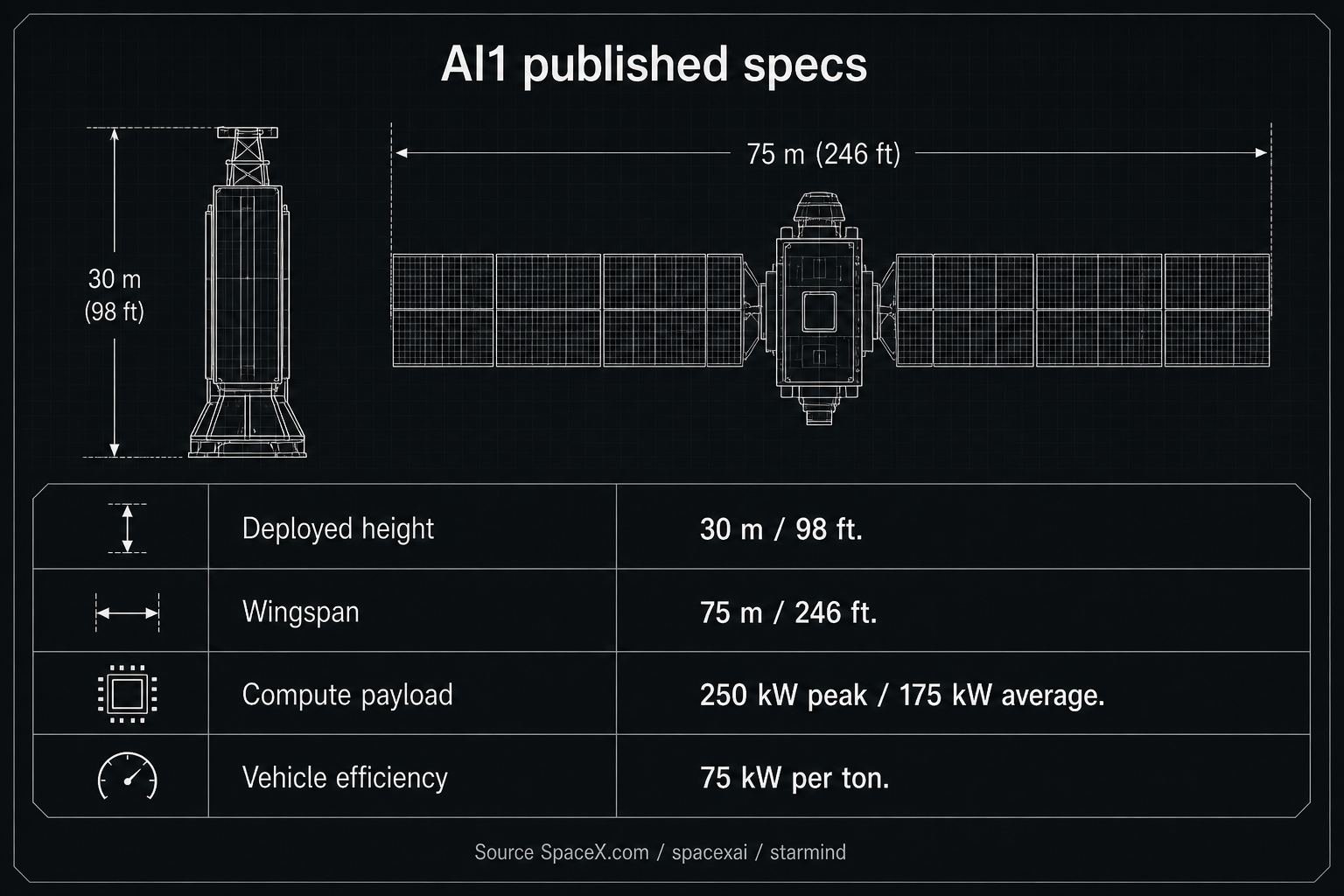
AI1, as printed
The live table is four lines. Deployed height: 30 meters, 98 feet. Wingspan: 75 meters, 246 feet. Compute payload: up to 250 kW peak, 175 kW average. Vehicle efficiency: 75 kW per ton. Those are the numbers on spacex.com/spacexai/starmind. This desk will not keep an older 120–150 kW line, or a 70-meter line, once the page has moved. 75 kW per ton is the efficiency on this page. It is not the hundred-kilowatts-per-ton path on another paper.
- Deployed height — 30 m / 98 ft
- Wingspan — 75 m / 246 ft
- Compute payload — up to 250 kW peak / 175 kW average
- Vehicle efficiency — 75 kW / ton
- Older 120–150 kW / 70 m notebook lines — not this page
How the page says it works
Satellites with localized AI compute, results beamed back from low-latency sun-synchronous orbit, are what SpaceX calls the fastest way to scale given the growing difficulty of finding electrical power on Earth. The satellites use proven technology and are more streamlined than the Starlink satellites already built at scale. The system is chip-vendor agnostic: compute modules from any provider. Heat radiates into vacuum. No chillers, cooling towers, fans, or dry coolers. SpaceX writes that this cuts cooling power overhead by an order of magnitude. High-speed lasers interconnect the satellites and beam results to Earth through Starlink.
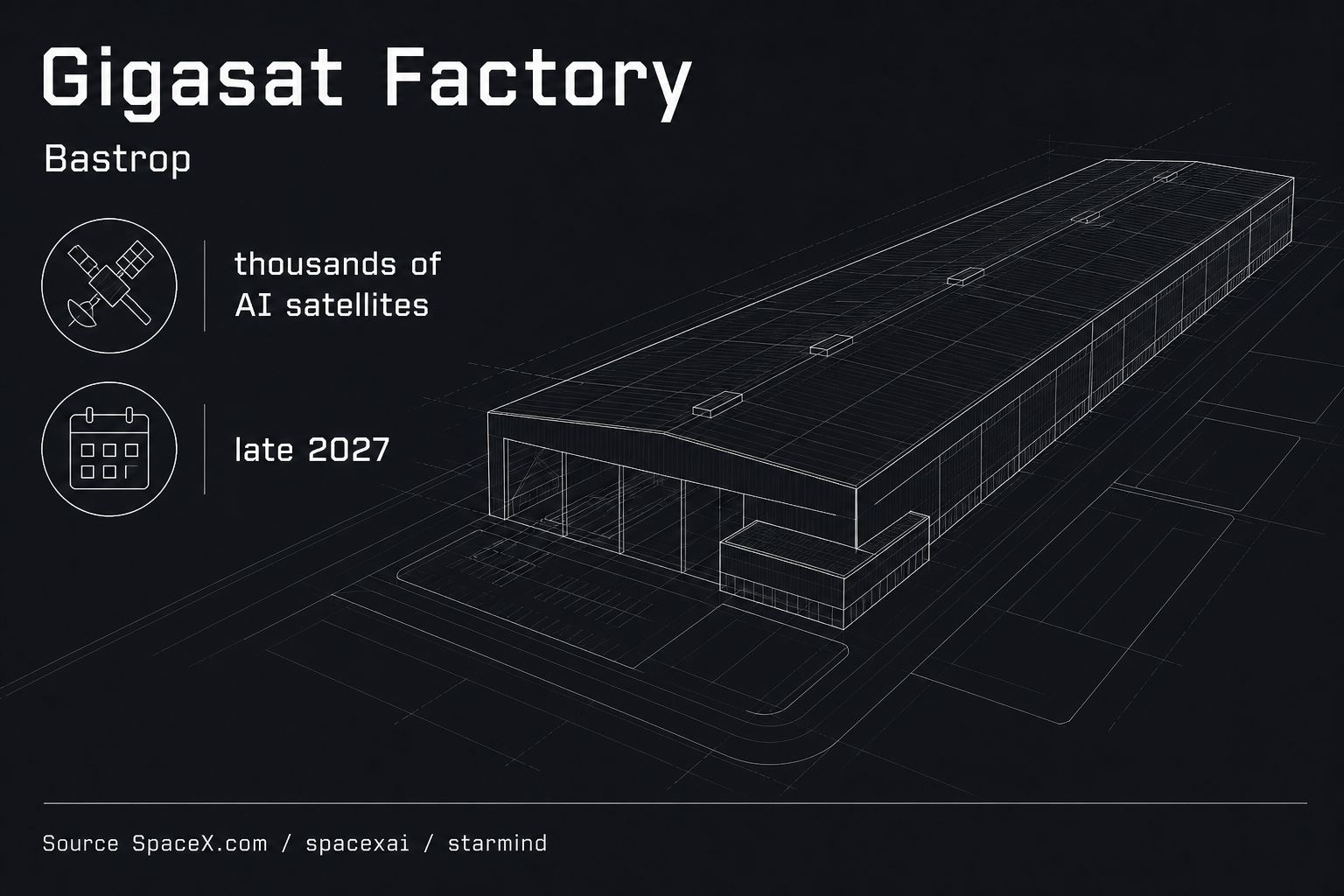
Gigasat Factory, Bastrop
SpaceX is building the Gigasat Factory in Bastrop to manufacture AI satellites at massive scale. The page says the facility is planned to enable rapid production and deployment of thousands of AI satellites starting as soon as late 2027. Late 2027 is the printed start. It is not a flown year. Thousands is the printed count. It is not a named constellation size. A factory is not a stack.
Three limits
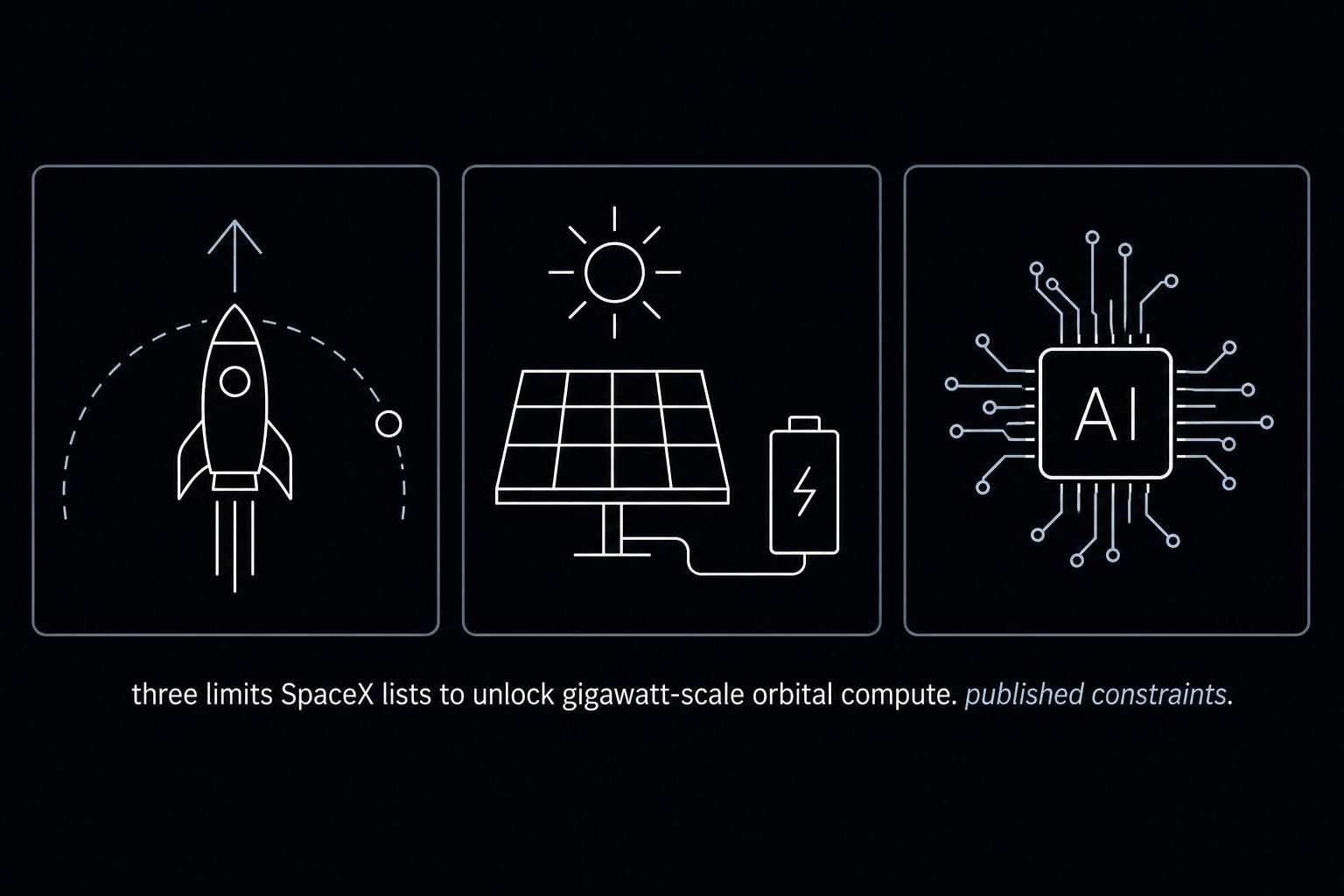
To unlock gigawatt-scale AI compute in space, the page lists three constraints that limit ground data centers: mass to orbit, power generation, and AI chips. Mass to orbit: Starship’s fully reusable architecture and unmatched payload capacity are called critical for deploying large, heavy AI satellites. Power: in sun-synchronous orbit, AI1 captures continuous solar power with no weather or atmospheric loss, and avoids Earth’s grid, land, and cooling. AI chips: SpaceX plans to produce advanced AI chips at scale in a new fab, a joint project with Tesla, using a modular architecture for next-generation processors. The fab sentence points at Terafab. That groundbreaking is already on this desk. This paper will not retell Grimes County.
What this note will not say
No landing year. No crew. No city on a solar wing. A planned factory in late 2027 is not a satellite that has flown. Official photoreal stills were not on the public page in a form this desk could keep. The figures here are house plates of the printed numbers, labeled SpaceX.com. They are not SpaceX film. A plate is not a constellation.
Selected primary sources
SpaceX, Starmind, https://www.spacex.com/spacexai/starmind. Live first-party page for AI1 (30 m / 98 ft deployed height; 75 m / 246 ft wingspan; up to 250 kW peak / 175 kW average; 75 kW per ton), sun-synchronous orbit and Starlink lasers, Gigasat Factory in Bastrop (thousands of AI satellites starting as soon as late 2027), three limits (mass to orbit, power generation, AI chips), and the Tesla joint fab line. Related desk papers, not this one: /research/terafab-texas, /research/terafab-backbone, /research/hundred-gigawatts-a-year. This desk used the live Starmind page and did not keep stale 120–150 kW or 70 m notebook lines. It did not invent a landing, a crew, a city, or a flown satellite.
Ask this paper
Grok answers from this essay only. Sign in so the call stays on your session — one question at a time.
Sign in to askNext
Starship Flight 14