Starship · Architecture · Hardware · 8 min read
Starship to Orbit
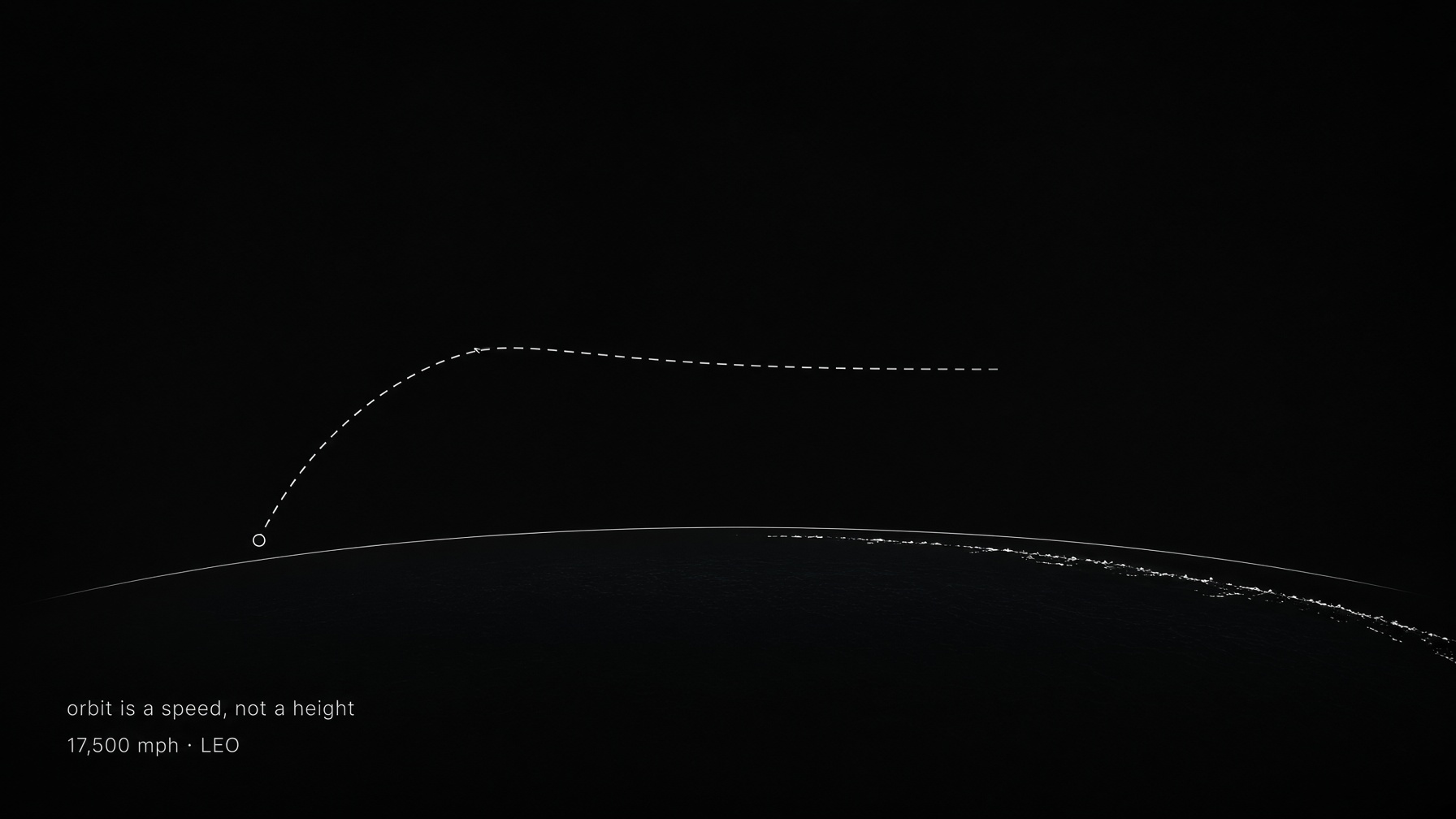
Orbit is a speed, not a height. A second burn is not a landing.
Starting with Flight 14
On 15 September 2026 SpaceX published an Updates post titled Starship to Orbit. The first sentence is the phase change this desk will keep: Starship is preparing to move into an exciting new phase — orbital flight. Starting with Flight 14, Starship will begin flying orbital missions that will enable it to begin delivering Starlink V3 satellites and other payloads to space, and conduct new flight tests like the first orbital propellant transfer.
That is the closed record. Flight 14 is named as the start of orbital missions. It is not printed as flown on this page. This desk will not invent a launch clock, a catch, or a splashdown result for Flight 14. The featured launch tile on spacex.com the same week is Starship Flight 14. A tile is a watch label. It is not a flown log.
- Phase — orbital flight, starting with Flight 14
- Payloads named — Starlink V3 satellites and other payloads
- New test named — first orbital propellant transfer
- Flown on this page — not Flight 14
Passively safe for thirteen
For the first 13 Starship flight tests, SpaceX says it intentionally placed the upper stage on a passively safe suborbital trajectory. When the engines turned off at the end of ascent, the ship did not have the forward velocity necessary to achieve orbit. Even if control were completely lost, the path was already set to reenter and splash down in a pre-determined location. That mission design gathered flight data while maximizing public safety.
For Starship’s initial orbital flights, the update says the vehicle will still be placed initially on a passively safe suborbital trajectory and will require a second burn to achieve orbit. After the initial ascent burn, Starship will be on the same passively safe suborbital trajectory to the Indian Ocean as its initial flight tests. Controllers assess health during a coast. Proceed to orbit, or let it reenter and splash down in the Indian Ocean. Assuming the vehicle is healthy, Starship executes a circularization burn using a single Raptor sea level engine that places the vehicle in orbit around Earth.
- Flights 1–13 — intentionally suborbital, passively safe
- Initial orbital flights — still start passively safe; second burn required
- Abort path named — Indian Ocean
- Circularization — single Raptor sea level engine
- Orbit on this page — a burn decision, not a flown Flight 14
What orbit means on this page
SpaceX’s explainer is speed, not altitude. Once an object clears obstructions, it has to move sideways fast enough — about 17,500 mph in low-Earth orbit — so that as gravity pulls it down, Earth curves away at the same rate. Fire a cannonball hard enough and the ground keeps dropping out from under it. That endless freefall is being in orbit.
Starship is unique in the history of upper stages, the update says, because it is designed to be fully reusable and to survive reentry intact. Multiple Starship vehicles have survived reentry despite flight experiments that removed tiles and stressed structure. Large size and robustness are why SpaceX took a deliberate suborbital approach before transitioning to orbital flights. Survived reentry is not a Mars entry. It is why a suborbital test program was allowed to exist before this phase.
As Starship flies its initial orbital missions, profiles are designed with opportunities to remain in passively safe suborbital trajectories or safely deorbit at multiple pre-determined ocean areas. On orbit, controllers monitor key systems — Raptor health, power, comms, flight computers, navigation sensors, tank and feedline integrity, tank pressure control, attitude control. More than 500 physical sensors measure temperature, pressure, acceleration, and more, plus component telemetry. At the end of a nominal mission, a deorbit burn with a single Raptor sea level engine puts the ship on a path for ocean splashdown or a return to launch site for catch and reuse.
- LEO sideways speed printed — about 17,500 mph
- Sensors — more than 500 physical sensors
- Deorbit — single Raptor sea level engine
- End states named — ocean splashdown, or return to launch site for catch and reuse
- Not on this page — a Flight 14 result, a Mars landing, a tanker already filled
Unlocking is not unlocked
The closing block is the architecture sentence, not a flown log. Orbital operations are a requirement. The outcome SpaceX prints: a spacecraft that will ultimately deploy hundreds of thousands of satellites, return humans to the Moon to build a permanent presence, and eventually send megatons of cargo and millions of people to space to make life multiplanetary.
This desk already carries the Mars-city architecture on Mission: upwards of one million people, millions of tonnes of cargo, several thousand Starships, more than ten launches a day in a ~26-month window. This Updates post does not move those numbers. It names the gate that makes tanker and cargo flights possible: orbit, then the first orbital propellant transfer. The 2026 gates on the V3 and flyby papers were a long-duration flight test and an in-space propellant transfer. This page names the transfer as orbital. It does not print a closed transfer. Ice still sits under dust. Return still wants about 2,400 tonnes of methane and oxygen cooked on Mars. Power still wants about 3.6 megawatts. Those loads have not moved.
- Satellites — hundreds of thousands (ultimate deploy claim)
- Moon — permanent presence (architecture)
- Cargo / people — megatons and millions to space (architecture)
- Transfer — first orbital propellant transfer named, not flown on this page
What this desk will not invent
No Flight 14 splashdown, catch, or Starlink deploy count as flown facts from this Updates page. (Desk note 2026-09-18: the launches page now prints a Flight 14 NET — as soon as Monday, September 28, pending regulatory approval — see companion /research/starship-flight-14; this Updates paper still carries no NET of its own.) No claim that orbital propellant transfer has already happened. No Louisiana delta from this Updates post — there is still no Starbase Louisiana / Vermilion / Pecan Updates slug. No pad count. No crew for Flight 14. A phase change is not a landing.
Selected primary sources
SpaceX Updates, “Starship to Orbit,” 15 September 2026, https://www.spacex.com/updates/orbital-starship (updateId=orbital-starship). Featured launch tile on spacex.com: Starship Flight 14 (link starship-flight-14) as of the 2026-09-17 desk sweep. The Updates post is the source for Flight 14 as the start of orbital missions, Starlink V3 and other payloads, the first orbital propellant transfer as a named test, the first-13 passively safe suborbital design, the Indian Ocean passively safe path, circularization and deorbit with a single Raptor sea level engine, about 17,500 mph in LEO, more than 500 physical sensors, and the hundreds-of-thousands / Moon / megatons / millions architecture close. SpaceX has not published a Flight 14 flown result on this page. This desk will not borrow one.
Ask this paper
Grok answers from this essay only. Sign in so the call stays on your session — one question at a time.
Sign in to askNext
Starship Flight 14