Starship · Hardware · Architecture · 10 min read
Starship V3
Third generation. Raptor 3. Thirty-three engines starting together. Four drogues for the tanker. A generation is not a city.
A generation is not a city
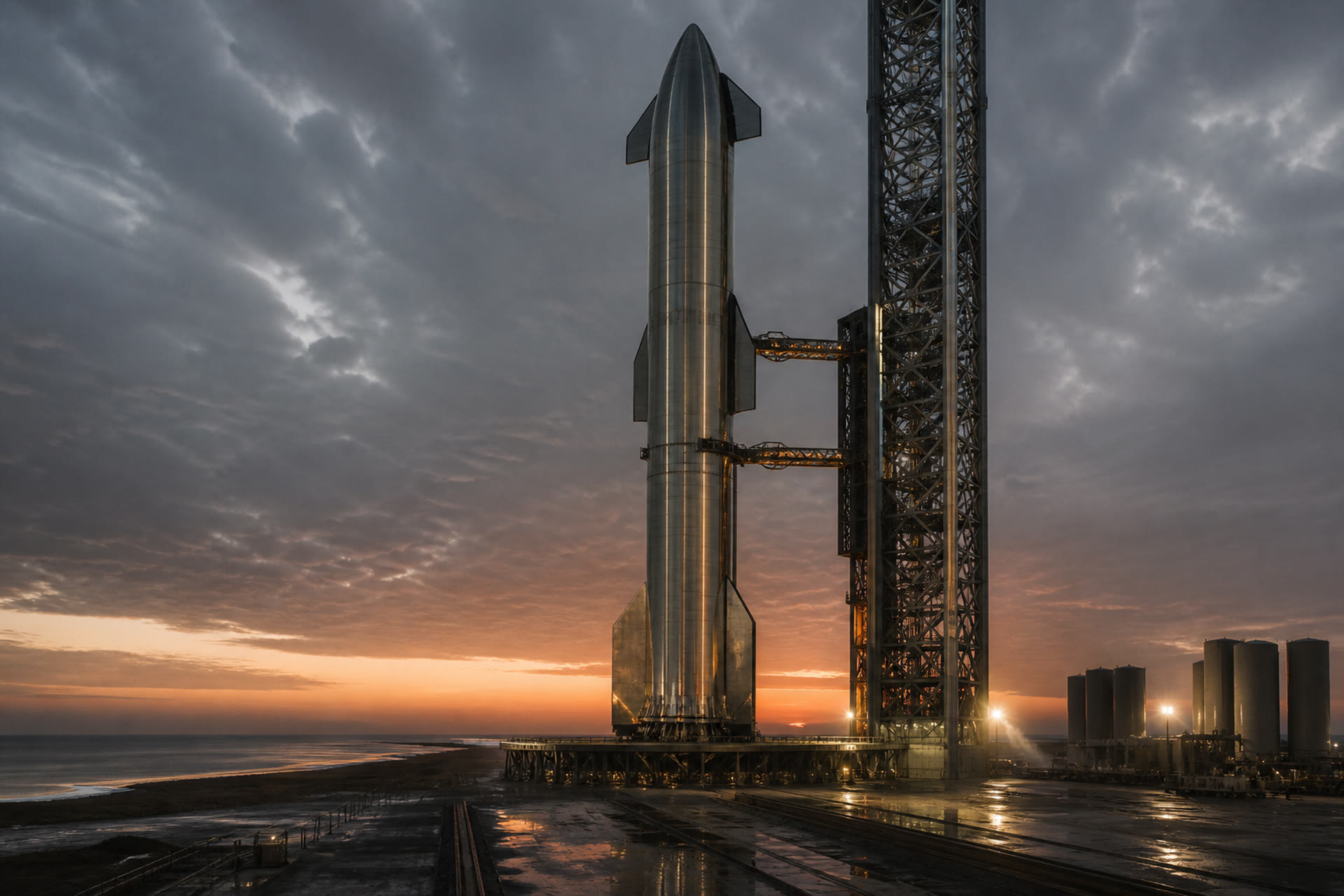
On 12 May 2026 SpaceX published the third generation of Starship and Super Heavy. Powered by Raptor 3. Launching from an entirely new pad. The sentence at the bottom of that update is the one this desk will keep: these elements are designed to unlock the vehicle’s core functions — full and rapid reuse, in-space propellant transfer, Starlink and orbital data centers, and the ability to send people and cargo to the Moon and Mars. Designed to unlock is not unlocked. A generation is a stack of hardware changes. It is not a self-sufficient settlement of a million people, and it is not a landed tonne on Mars. This paper is the hardware SpaceX actually printed. Flight 12, the update said, will mark the first launch from Pad 2 at Starbase. This desk will not invent what that flight did. It will stay with the parts list.
Raptor 3
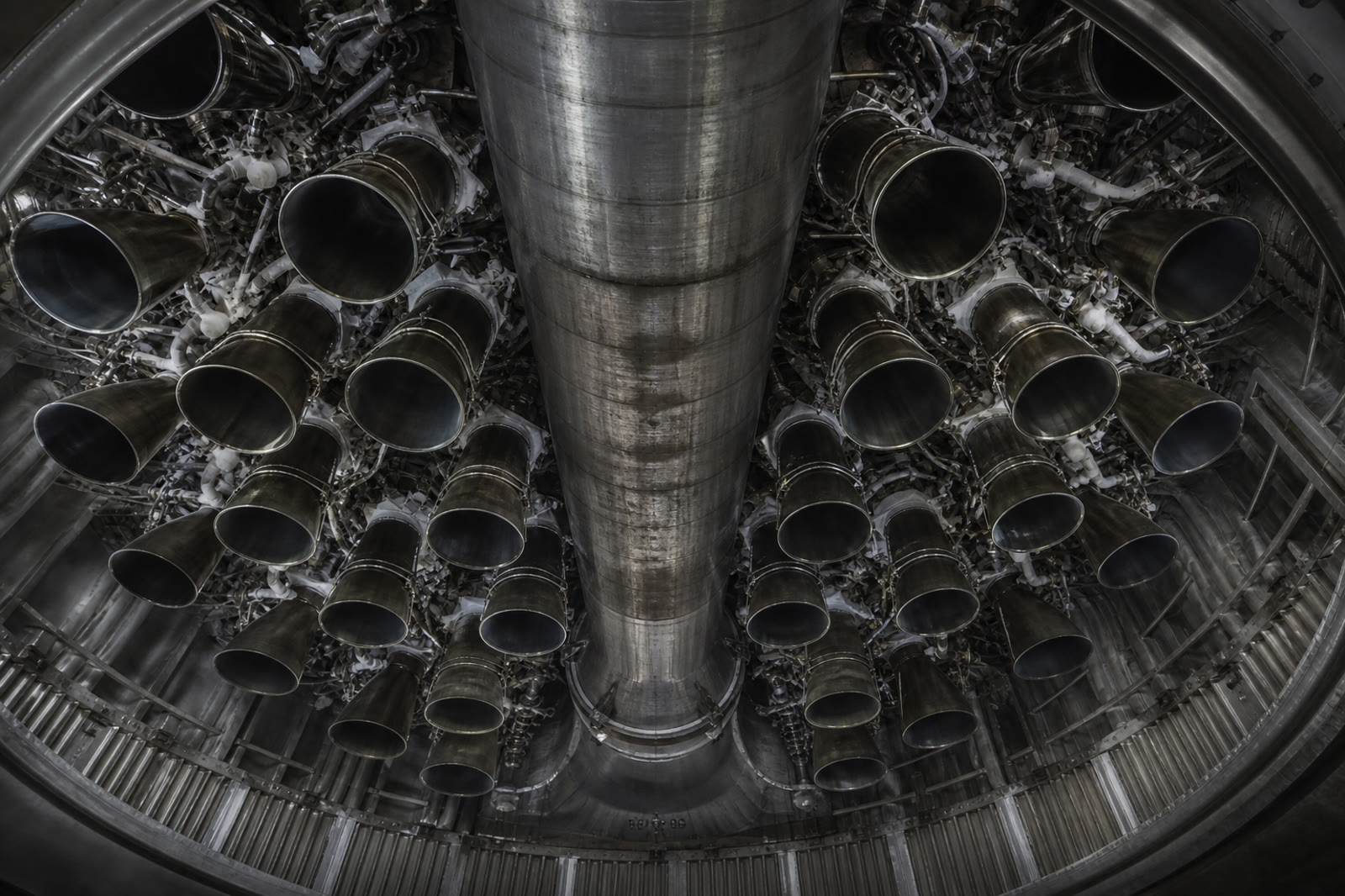
The engine is why the rest of the stack can get lighter. Sea-level Raptor 3 now produces 250 tf (551,000 lbf), up from 230 tf (507,000 lbf). Vacuum Raptor 3 produces 275 tf (606,000 lbf), up from 258 tf (568,000 lbf). Sea-level mass dropped to 1,525 kg from 1,630 kg. Vehicle-level savings reach about one ton per engine once you count the engine itself, the vehicle-side commodities, and the supporting hardware that used to live around it. Sensors and controllers are now internally integrated and covered by engine thermal protection. That is why both ship and booster can delete the individual engine shrouds. Every variant gets a redesigned ignition system. As of the 30 October 2025 “To the Moon and Beyond” desk, SpaceX had more than 40,000 seconds of run time on Raptor 3 and more than 226,000 seconds on Raptor 2, across more than 600 engines produced. Runtime is not a closed architecture. It is why a clean-sheet aft end was allowed to exist.
- Sea-level — 250 tf (551,000 lbf), up from 230 tf
- Vacuum — 275 tf (606,000 lbf), up from 258 tf
- Sea-level mass — 1,525 kg, down from 1,630 kg
- Vehicle-level savings — about 1 ton per engine
- Shrouds — deleted; sensors and controllers live under engine thermal protection
- Raptor 3 runtime — more than 40,000 s as of 30 Oct 2025
Thirty-three at once
Super Heavy V3 is not a paint revision. Grid fins went from four to three. Each remaining fin is 50 percent larger and significantly stronger, with a new catch point, re-clocked for lift and catch, and lowered to take less heat from the ship’s engines during hot-staging. The shaft, actuator, and fixed structure now live inside the booster’s main fuel tank. An integrated hot stage replaces the single-use protective interstage. The forward dome of the booster fuel tank is now directly exposed to the ship’s Raptors at ignition; tank pressure and a non-structural layer of steel do the work the discarded interstage used to do. Interstage actuators retract after separation so they are not sitting in exhaust. The fuel transfer tube that feeds those thirty-three engines was redesigned and is now roughly the size of a Falcon 9 first stage. That tube is why all 33 can start simultaneously, and why the flip can be faster and more reliable. Aft thermal protection was rebuilt around fluids, power, and networking to the 33. Large individual engine shrouds are gone. Shielding sits between engines and around thrust-vector hardware on the inner 13. The carbon-dioxide fire suppression system left with the aft cavity. The booster went from one quick disconnect to two physically separated pad connections. Redundancy, smaller mechanisms. None of this is a Mars landing. It is how a booster becomes a thing you catch twice in a day.
- Grid fins — three, not four; each 50% larger; catch point; re-clocked; lowered
- Hot stage — integrated; discarded single-use interstage
- Transfer tube — Falcon 9 first-stage scale; 33 engines start together
- Inner 13 — thrust-vector hardware shielded; shrouds deleted
- Pad interfaces — two separated quick disconnects, not one
The ship that can wait
Starship V3 is a clean-sheet propulsion redesign: a new Raptor startup method, more propellant tank volume, a better reaction-control system, and fewer aft volumes that can trap a leak. Aft fluids and electrics were rerouted so the individual engine shrouds and the large aft close-out volume could go. The aft flap went from two actuators per flap to a single actuator with three motors — more redundancy for a return-to-launch-site, less mass, less cost. The Starlink PEZ dispenser got new actuators and inverters. The long-duration sentence is the one that matters for a tanker and for a flyby. More efficient RCS. Isolation valves on high-pressure gas. 100 percent vacuum jacketing on the header feed system. A high-voltage electrically actuated cryogenic recirculation system. A dedicated system for managing cryogenic propellant interactions with the engines during extended coasts. Four docking drogues on the leeward side, plus propellant feed connections for ship-to-ship transfer. Those four drogues are the hardware that turns a heavy-lift vehicle into a stack that can be filled in orbit. They are not a flown transfer. SpaceX has already moved about five metric tons of cryogenic propellant between tanks on one ship. That is a different experiment. Ship-to-ship is the 2026 gate. This desk will not let a drogue grow a tanker it has not met.
- Clean-sheet propulsion — new startup, more tank volume, fewer leak traps
- Aft flap — one actuator, three motors, not two actuators
- Header feed — 100% vacuum jacketing
- Coasts — dedicated cryogenic management at the engines
- Four docking drogues — leeward side, plus ship-to-ship feed connections
- Flown cryo move — ~5 t between tanks on one ship; not ship-to-ship
Nine megawatts and a new pad
About sixty custom avionics units sit at the heart of the two vehicles. They integrate batteries, inverters, and high-voltage distribution and can deliver about 9 MW of peak power across the stack, with distributed fault isolation. Multi-sensor navigation is built for autonomous flight with redundancy across phases and weather. New radio-frequency sensors are there to measure propellant in microgravity before the transfer demonstration. About fifty camera views ride on 480 Mbps of redundant Starlink. Pad 2 is the other half of the generation. The farm has more storage and more pumps for a faster fill. Chopsticks are shorter, for faster catch tracking; their main actuators went from hydraulic to electromechanical. The ship quick-disconnect arm is stronger, repackaged, and swings farther away at liftoff. The mount and hold-downs were redesigned for load sharing, throwback, and fly-out. A new bidirectional flame diverter and top-deck deflector are meant to stop ablation so those surfaces do not need a rebuild after every launch. Booster quick disconnects moved to the opposite side of the mount and split into separate methane and oxygen mechanisms. Vent valves, isolation valves, and filters for booster fill now live in a hardened bunker, oxygen and methane in separate rooms. A pad that does not need a week of tile work is how a factory rate becomes a flight rate. It is still a pad, not a city.
- ~60 custom avionics units · ~9 MW peak across the vehicles
- ~50 camera views · 480 Mbps redundant Starlink
- RF propellant gauging — for the transfer still ahead
- Flight 12 — first launch named from Pad 2 (12 May 2026 update)
- Chopsticks — shorter; hydraulic to electromechanical
- Flame surfaces — bidirectional diverter; designed for no post-launch rebuild
Six hundred cubic meters, one thousand hulls
The V3 update does not reprint the cabin. The 30 October 2025 page does. One Starship has more than 600 cubic meters of pressurized habitable volume — roughly two-thirds of the International Space Station — and two airlocks of about 13 cubic meters each, more than double the Apollo lander. Cargo variants are claimed at up to 100 metric tons directly to a surface. Those are vehicle sentences. They are not a V3 flight result, and they are not a Mars landing. The factory sentence lives on the Starship vehicle page: Starfactory is built to produce up to 1,000 Starships a year. SpaceX is also building Gigabay integration halls in Florida and Texas, each targeted for the end of 2026, and a Starship pad at LC-39A. A thousand hulls a year is a production claim. It is not a flown cadence, and it is not a reason to staff a flyby with a million people. Production is how a tanker fleet exists. A tanker fleet is how the 2026 transfer test becomes a departing stack. Mixing the factory rate with a city is how stainless steel becomes a settlement on a homepage.
- Habitable volume — more than 600 m³ (~2/3 ISS)
- Airlocks — two, ~13 m³ each
- Cargo lander claim — up to 100 t to a surface
- Starfactory — up to 1,000 Starships a year (vehicle page)
- Gigabay — Florida and Texas, targeted end of 2026
The desk load
The 2026 gates have not moved. A long-duration flight test and an in-space propellant transfer flight test are both targeted for 2026, with timing driven by how V3 flight tests progress. V3 is the clock. It is not the close. Four drogues and a Falcon-9-scale transfer tube are why those tests can be attempted on this generation. They are not a substitute for watching cryogenic methane and oxygen move between ships in orbit. The flyby paper already said it: without that transfer, Starship stays a heavy-lift vehicle. Ice still sits under meters of abrasive dust. Return still wants about 2,400 tonnes of methane and oxygen cooked on the surface. Power still wants about 3.6 megawatts of baseload. Those loads live in The Last Meters of Dust and Powering Mars. They are not this paper. This paper is the stack SpaceX printed on 12 May. Third generation. New pad. Raptor 3. Thirty-three at once. Four drogues. The city is a different machine.
Selected primary sources
SpaceX Updates, “Introducing Starship V3,” 12 May 2026, https://www.spacex.com/updates/starship-v3. SpaceX Updates, “To the Moon and Beyond,” 30 October 2025, https://www.spacex.com/updates/moon-and-beyond. SpaceX Updates, “FUTURE OF BUILDING STARSHIP,” 3 March 2025, https://www.spacex.com/updates/building-starship. SpaceX, “Starship,” https://www.spacex.com/vehicles/starship. The 12 May 2026 V3 desk is the source for Raptor 3 thrust and mass, the three 50-percent-larger grid fins, the Falcon-9-scale transfer tube and simultaneous 33-engine start, the four leeward docking drogues and ship-to-ship feed connections, 100 percent header vacuum jacketing, ~60 avionics units and ~9 MW, ~50 views at 480 Mbps, Pad 2 as Flight 12’s first pad, and the chopsticks, mount, and flame-diverter changes. The 30 October 2025 page is the source for more than 600 m³ habitable volume, dual ~13 m³ airlocks, ~5 t between-tank cryogenic transfer, and more than 40,000 seconds of Raptor 3 runtime. The vehicle page is the source for Starfactory’s up-to-1,000-ships-a-year claim. SpaceX has not published a ship-to-ship transfer result or a Mars landing on this generation. This desk will not borrow one.
Ask this paper
Grok answers from this essay only. Sign in so the call stays on your session — one question at a time.
Sign in to askNext
Starship Flight 14